|
Which
DDR RAM?
The
problem
You
want to purchase an ECS K76SA motherboard, and 256MB of
PC2100 or PC2700 DDR RAM. You want to run an AMD
Duron 1.3GHz processor on the motherboard's front-side bus
(FSB) that runs at 200MHz with this processor installed. You know
that both PC2100 and PC2700 DDR RAM run faster than 200MHz, so
you want to know if the RAM you purchase will be able to run at
the slower bus speed used by the processor.
Answer
Even
though the processor has a maximum speed (frequency) of 1.3GHz
(1300MHz), the effective data transfer rate of the processor is
limited to the speed (frequency) of the motherboard's FSB, which
in this case, doubled by DDR technology, is only 200MHz. The FSB
speed is the speed with which the processor is able to communicate
with the rest of the system. It can do its own calculations at
1.3GHz, but, in this case, can only communicate with the rest
of the system at 200MHz. This is going to limit the effective
speed of the DDR RAM, because the RAM can but won't tranfer data
faster than the processor.
The
chipsets on AMD Athlon/Duron motherboards allow the RAM bus to
run at a different speed from the processor bus.
For
example, the base FSB on the above ECS motherboard running a Duron
processor is 100MHz, because that is the FSB used by that processor.
The processor is able to operate at the DDR (double-data rate),
which is 200MHz. (Later Athlon processors use a 133MHz FSB.) If
PC133 SDRAM, which runs at 133MHz, is used, the Duron processor
has an effective data transfer rate that is 67MHz faster than
the RAM, so in this case the slower RAM is creating the bottleneck
that is limiting the data transfer speed. But with DDR RAM installed,
the processor's effective data transfer speed would be responsible
for creating the bottleneck.
Below
is a table providing information on the different types of DDR
RAM.
|
Names
|
Base
FSB Speed |
DDR
RAM Speed |
| PC-1600
or DDR-200 |
100MHz |
200
MHz |
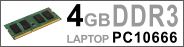
| PC-2100
or DDR-266 |
133MHz |
266
MHz |
| PC-2400
or DDR-300 |
150MHz |
300
MHz |
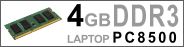
| PC-2700
or DDR-333 |
166MHz |
333
MHz |
| PC-3200
or DDR-400 |
200MHz |
400
MHz |
If
you purchase PC2700 RAM, the Duron 1.3GHz processor runs on a
base FSB of 100MHz, doubled to give an effective data transfer
speed of 200MHz, while the RAM runs on a base FSB of 166MHz, which
is effectively 333MHz using the DDR technology. So, in this case,
the processor is creating the bottleneck by having an effective
data transfer rate that is 133MHz slower than the RAM.
The
motherboard's manual provides the information on the types of
RAM that the motherboard can run. You must set the RAM clock speed
(in the BIOS, or by setting jumpers on the motherboard) to the
speed of the RAM that your purchase. This is 133MHz for PC2100
and 166MHz for PC2700 DDR RAM.
Therefore,
if you wanted the RAM speed to match the processor speed, you
would install PC1600 DDR RAM. However, you could purchase the
highest type of DDR RAM supported by the motherboard. If you decided
to upgrade the processor to the highest AMD Athlon processor that
it supports, that processor will run on a base FSB of 133MHz,
providing an effective data transfer speed of 266MHz. The ECS
motherboard supports PC2700 DDR RAM, so if that is installed with
the new processor, the effective data transfer rate would be increased
from 200MHz to 266MHz, and the bottleneck between the RAM and
processor would be reduced from 133Mhz to 66MHz.
The latest
AMD XP processors run on a base FSB of 166MHz (DDR 333MHz), so
they will transfer data across the system bus at the same speed
as PC2700 (DDR 333) RAM. But PC3200 (DDR 400) RAM runs at 400MHz,
so the base motherboard FSB would have to run at 200MHz for one
of these processors to transfer data across the system bus at
the same speed as PC3200 RAM.
Some
memory questions
Does
it matter which slots I plug my new module in?
In
general, you will get the best performance if you put the largest
module (in megabytes) in the lowest-numbered slot. For example,
if your computer comes with 32MB of removable memory and you
want to add 128MB, it would be best to put the 128MB module
into slot 0 and the 32MB module into slot 1.
Why
Does the Price of Memory Fluctuate?
Supply
and demand. Occasional changes in market demands will alter
inventories and, therefore, raise or lower prices.
Can
you mix and match ECC and non-parity modules?
No.
When adding new memory, you need to match what is already in
your system. You can determine if your system has parity by
simply counting the number of black memory chips on each module.
Parity and ECC memory modules have a chip count divisible by
three or five. Any chip count not divisible by three or five
indicates a non-parity memory module.
Can
DDR and SDRAM be used in the same system at the same time?
No.
Even though there are systems that support both technologies,
you can't have DDR and SDRAM in the same system at the same
time. You'll have to choose one or the other.
"Have
you ever gotten a "great deal" on a system and then been a little
disappointed with its overall performance? If so, this article
on Crucial's Web site is for you. Get the information you need
to figure out whether or not upgrading your system would be
worth the money.
What
are MultiMediaCards?
About
the size of a postage stamp, a MultiMediaCard, or MMC, is a
small, removable storage device used in a variety of electronic
devices, including digital cameras, handheld computers, and
digital music players. MultiMediaCards are designed with flash
technology, a non-volatile storage solution that does not lose
its information once power is removed from the card. MultiMediaCards
contain no moving parts and are extremely rugged, providing
users with much greater protection of their data than conventional
magnetic disk drives.
For
answers to more of your memory questions, visit the Crucial
FAQ Centre at -
http://support.crucial.com/scripts/ukcrucial.exe/faq
RAM
diagnostic utilities
Memtest-86
3.0
http://www.memtest86.com./
MemTest
v1.2 [9k] W9x/2k/XP - free - http://www.mywebattack.com/gnomeapp.php?id=105570
and
http://www.simmtester.com/page/products/doc/download.asp
RAM
websites
The
"Ultimate Memory Guide." - http://www.kingston.com/tools/umg/default.asp
If
you want to know about the technical details of how RAM
works, visit this article. -
Computer Memory Help - All Help you need on Computer Memory.
RAM
News
RAM
Wars: Return of the JEDEC
JEDEC
= Joint Electronic Device Engineering Council
"DDRAM
comes into its own right for mainstream and performance PC applications
while muscling out SDRAM and Rambus. Here's our analysis of the
world of PC memory as it is being shaped by DDR. We also take
a look at GDRII and GDRIII."
"This
year will bring a radical change in the kind of memory you will
buy and how you will buy it. The death knell has begun to sound
for SDRAM while DDRAM has become a standard memory device. A bevy
of new memory capabilities, such as dual channel DDR, will make
life that much more interesting."
http://www.tomshardware.com/mainboard/20030401/index.html
Rambus
RAM exceeds 1GHz
Rambus
RAM is now available running at a frequency exceeding 1GHz. The
new 1006MHz (1.006GHz) Rambus RAM, combined with Intel's 850E
chipset and the latest Pentium 4b processor, takes full advantage
of the latest 533MHz motherboard front side bus (FSB) frequency.
Asus is the first motheboard manufacturer to issue a motherboard
- the P4T533 - that supports the new memory.
Micron
(Crucial) demo the next generation of memory technology
http://www.simmtester.com/page/news/shownews.asp?num=4597
Reported
Memory Does Not Match Installed Memory
RAM
information from Microsoft
"When
you view the Performance tab in System properties, the amount
of memory reported may differ from the actual amount of memory
installed in the computer. This behavior can occur for any of
the following reasons: Himem.sys is not using all the memory on
an EISA computer. A driver or program loading from the Config.sys
or Autoexec.bat file is claiming a portion of random access memory
(RAM). A virtual device driver loading from the System.ini file
is claiming a portion of RAM. A protected-mode driver is causing
the memory mismatch. The registry is damaged. A CMOS setting is
disabling some of the RAM. You have the 'maxphyspage=' setting
in your System.ini file set to restrict Windows from using some
of the installed memory. Ramdrive.sys is being loaded in the Config.sys
file. You are using a video adapter that is integrated into the
motherboard." -
http://support.microsoft.com/default.aspx?scid=kb;EN-US;Q146912
DDR
SDRAM and Rambus RAM --
What is RAM and what does it do?
-- Which DDR RAM? -- How
to install RAM? -- How
to identify the size of RAM modules? -- Different
types of RAM? -- Mixing brands
can often cause problems -- Memory
Frequently Asked Questions
|